Key points
- UTM and NGFW features overlap
- Application controls vary by product
- Test throughput with security services enabled
- Compare total subscription and support cost
- Match management complexity to team capability
In this article
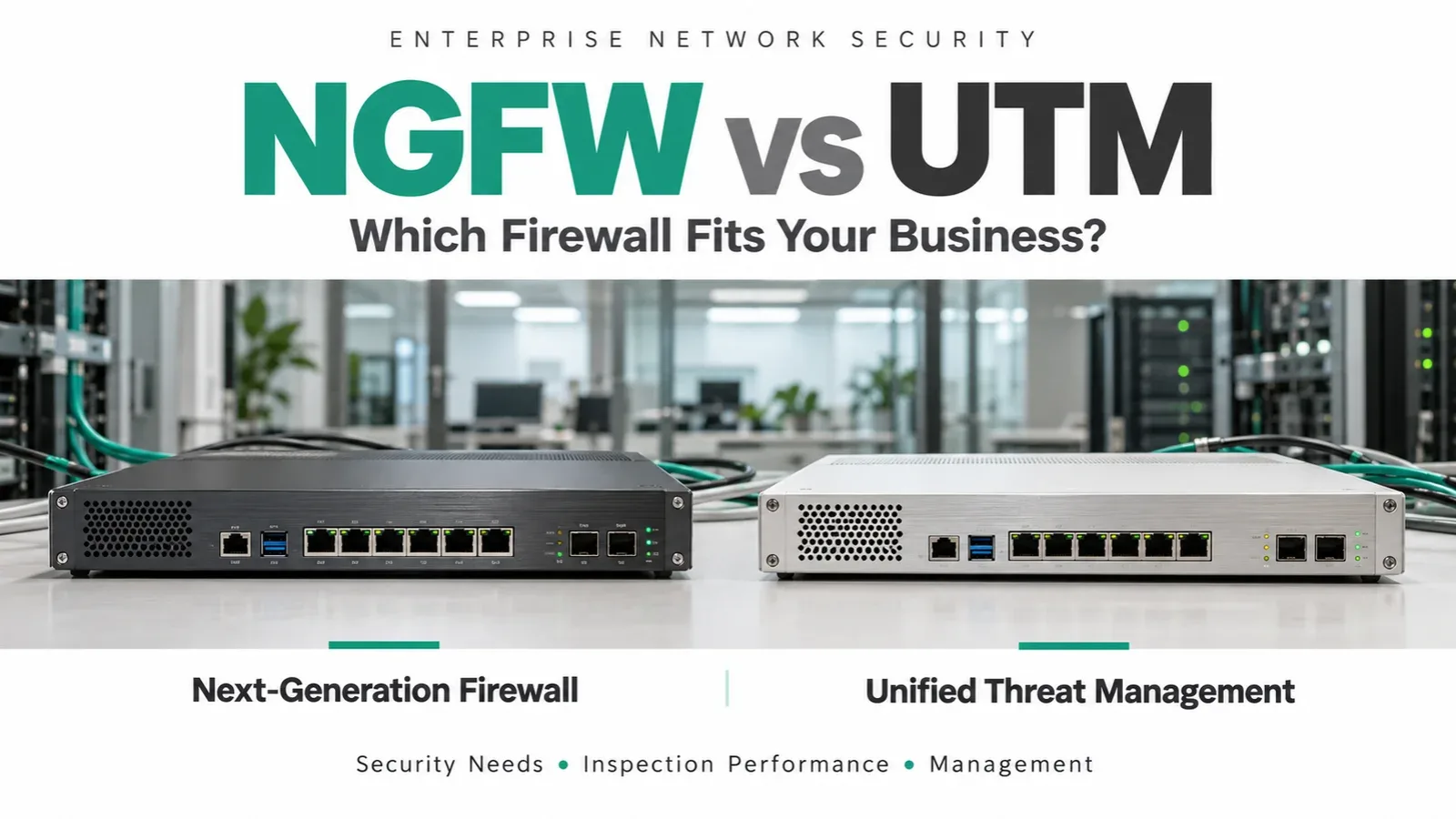
Choosing a business firewall requires a clear view of the traffic, applications and security controls it must support. UTM (Unified Threat Management) and NGFW (Next-Generation Firewall) are two common labels used for integrated network security products.
UTM and NGFW describe overlapping approaches to firewall security. UTM emphasizes combining security functions, while NGFW emphasizes application-aware inspection and integrated threat prevention. Actual differences depend on the product, software, license and sizing.
What Is a UTM Firewall?
A Unified Threat Management (UTM) firewall is an all-in-one security appliance that combines multiple security functions into a single device.
Common UTM Features, Depending on Product and License
- Stateful firewall
- Antivirus / Anti-malware
- Intrusion Prevention System (IPS)
- Web filtering
- Email security
- VPN (IPsec / SSL)
Key Strengths of UTM
- Simple deployment and management
- Potential cost and management benefits in a suitably sized environment
- Centralized security controls
UTM Evaluation Limits
Inspection-enabled throughput and connection capacity must be checked for the selected model.
Application control and scalability vary across products. A UTM label alone does not establish that these capabilities are limited.
An integrated security appliance can suit a smaller team when its capacity, features and support match the environment.
What Is a Next-Generation Firewall (NGFW)?
A Next-Generation Firewall (NGFW) goes beyond traditional firewalling by providing deep visibility, application awareness, and advanced threat prevention.
Common NGFW Capabilities, Depending on Product and License
- Application-aware firewalling (Layer 7)
- Deep packet inspection (DPI)
- Integrated IPS
- User and identity-based policies
- Advanced threat prevention
- SSL/TLS traffic inspection
- Supported integrations with endpoint, monitoring and identity systems
Key Strengths of NGFW
Performance and scalability depend on model, enabled inspection and workload.
- Fine-grained application control
NGFW options cover branch, enterprise and data-center deployments. Select against the required traffic profile and control requirements.
NGFW Evaluation Limits
Total cost depends on hardware or hosting, subscriptions, management, support and implementation.
- Requires skilled security management
- More complex initial configuration
NGFWs can suit application-aware and identity-based security designs. Neither the product label nor the advertised raw throughput proves suitability for a particular deployment.
NGFW vs UTM: Key Differences
Security approach: UTM combines multiple controls. NGFW emphasizes application-aware inspection and threat prevention. These approaches overlap.
Application and identity controls: Check actual application recognition, user mapping and policy granularity on the selected product.
Performance and scalability: Compare inspection-enabled throughput, connections, users and future capacity under equivalent conditions.
TLS inspection: Check supported protocols, certificate handling, exclusions and the performance impact of decryption.
Integration and Zero Trust: Verify supported EDR, XDR, SIEM and identity integrations. Neither firewall label establishes a complete Zero Trust architecture.
Operational fit: Consider deployment complexity, staff skills, subscriptions, support and total cost rather than assigning all SMBs to UTM and all enterprises to NGFW.
Why Organizations Evaluate Application-Aware Firewalls
1. Rise of Application-Layer Attacks
Application-aware controls can help distinguish allowed services from unwanted traffic using the same port. Confirm application coverage and policy behavior on the exact platform.
2. Growth of Encrypted Traffic
Encrypted traffic inspection is available on different integrated firewall products. Compare supported protocols, exclusions and TLS-inspection throughput rather than assuming all NGFWs outperform all UTMs.
3. Zero Trust & Identity-Based Security
Identity integrations can support user-aware policies. They are one control within a wider Zero Trust architecture, rather than evidence that the firewall alone delivers Zero Trust.
4. Performance Demands
Cloud applications, remote access and higher bandwidth can increase inspection and connection requirements. Size the device for peak traffic with the intended security services enabled.
Choose a firewall by tested capabilities and operational fit. UTM and NGFW features overlap, and either label can cover products with different performance, subscription and integration limits.
Practical Next Step
Prepare your traffic profile, inspection requirements, availability needs and support expectations before requesting a quotation. Discuss firewall requirements with Servicing24 Limited.
Sources and Further Reading
Common questions
What is the main distinction between UTM and NGFW?
UTM emphasizes bundling security functions, while NGFW emphasizes application-aware inspection and integrated threat prevention. The categories overlap.
Is every NGFW faster than every UTM?
No. Performance depends on hardware or hosting, software, traffic and enabled security services. Compare equivalent test conditions.
Can a small business use an NGFW?
Yes. The relevant issues are model sizing, subscription cost, required features and the team’s ability to manage the policies.
Can UTM products offer application control or TLS inspection?
Some can. Check the exact product, software release and subscription rather than assuming the category excludes those features.
What should be included in a firewall comparison?
Include application and identity controls, inspection throughput, session limits, availability, logging, management, integration, subscriptions and support.
Need help with this in your own setup?
Talk to a Servicing24 engineer. We’ll give you a plan and a clear price.