Key points
- Platforms differ in enforcement layer and workload support
- Vendor examples are not a performance ranking
- Policy orchestration differs from direct enforcement
- Discover application dependencies before blocking flows
- Pilot policies and test required services
In this article
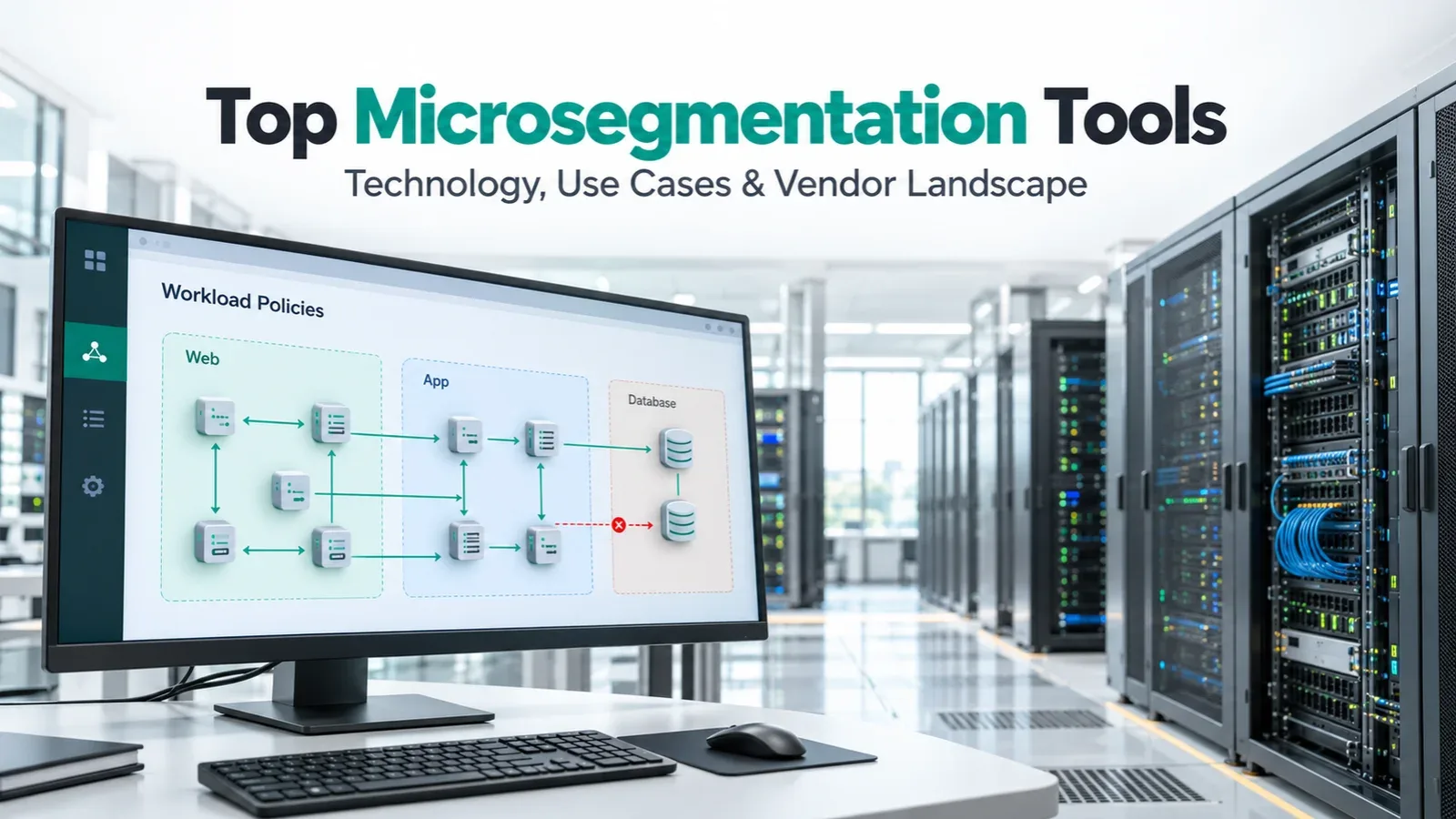
A compromised system can expose other reachable workloads when internal access is too broad. Microsegmentation applies fine-grained communication policies to workloads or application groups, helping limit unauthorized lateral movement alongside other security controls.
The approach can be useful across data centers, virtual machines, containers and cloud workloads. Its value depends on supported enforcement points and accurate application dependencies.
What Is Microsegmentation and How It Works
Microsegmentation defines which workloads may communicate and under what conditions. Policies can be enforced at hosts, virtual interfaces, container networks or cloud controls, depending on the product and deployment.
How It Works
Microsegmentation tools typically follow these steps:
Discovery & Mapping
Tools automatically map network traffic flows and application dependencies so security teams can see how assets communicate.
Policy Definition
Based on the observed behavior, administrators create fine-grained rules determining which segments or services can communicate.
Enforcement
Policies are enforced at the workload or host level, typically using host firewalls, hypervisor controls, or network-based enforcement points.
Monitoring & Adjustment
Ongoing monitoring ensures policies reflect actual use and adapt to changes in architecture.
Microsegmentation supports least privilege and containment within a Zero Trust architecture. It does not replace identity security, endpoint protection, monitoring or recovery.
Microsegmentation Tools and Related Platforms
The following are examples from the vendor landscape, rather than a performance ranking. They operate at different layers and are not interchangeable. Verify current licensing, supported systems and enforcement coverage for the intended deployment.
1. Illumio Segmentation
Illumio Segmentation provides workload communication visibility and policy-based movement controls across supported cloud, data-center and endpoint environments. It can suit teams evaluating segmentation across heterogeneous workloads.
2. Cisco Secure Workload
Cisco Secure Workload, formerly known as Tetration, offers application visibility and microsegmentation through supported agent-based and agentless enforcement approaches. Check the compatibility matrix and the enforcement points required by the design.
3. VMware NSX and vDefend Distributed Firewall
NSX-based distributed firewalling supports granular controls close to virtual workloads. Current VMware vDefend offerings include Distributed Firewall capabilities. Confirm the supported platform, version and commercial entitlement rather than assuming that every NSX deployment includes the same security features.
4. Akamai Guardicore Segmentation
Akamai Guardicore Segmentation offers application visibility and software-based communication policies across supported environments. Evaluate agent coverage, dependency mapping and staged policy rollout for the workloads in scope.
5. AccuKnox Microsegmentation
AccuKnox offers workload communication controls alongside runtime security. Its KubeArmor-related runtime protection addresses process behavior as well as access restrictions. Network segmentation and runtime protection have different enforcement scopes, so confirm which controls the selected deployment provides.
6. Tufin
Tufin focuses on security-policy visibility, simulation, change management and orchestration across supported platforms. It is useful when segmentation depends on coordinating multiple enforcement systems, rather than treating every network boundary as one standalone host-agent product.
7. Calico (Tigera)
Calico provides network-policy controls for Kubernetes workloads. Open-source and commercial editions differ in management and policy features. Installing Calico alone does not establish a least-privilege policy for every workload.
8. Zscaler Microsegmentation
Zscaler Microsegmentation uses an agent-based architecture for workload visibility, policy recommendations and local enforcement. Workload microsegmentation should be evaluated separately from user-to-application access controls such as ZTNA.
Why Organizations Evaluate Microsegmentation
1. Enhanced Protection Against Lateral Threats
Internal controls can restrict east-west communication that does not traverse a perimeter firewall. The effectiveness depends on actual traffic paths, policy coverage and management of exceptions.
2. Zero Trust Adoption
Security today emphasizes “never trust, always verify.” Microsegmentation enforces least-privilege access within internal networks, aligning with Zero Trust principles.
3. Hybrid & Multi-Cloud Complexity
With workloads spread across on-premises, private, and public cloud environments, microsegmentation tools help maintain consistent security policies.
4. Compliance & Risk Mitigation
Workload visibility and controlled communication can support risk reduction and audit evidence. A segmentation product or deployment does not establish compliance by itself.
Future Vision: Where Microsegmentation Is Headed
AI-Assisted Policy Automation
Policy discovery and recommendations can reduce manual effort. Teams still need to validate dependencies, confirm application ownership and test the effect of enforcement.
Cloud-Native Integration
Cloud and container integrations can extend segmentation to additional environments. Coverage and feature parity vary by operating system, cloud service and edition.
Runtime Security and Detection
Some platforms combine segmentation with runtime or threat signals. Confirm the supported integrations and the authority to change policies during an incident.
Unified Policy & Visibility
Unified visibility and policy management are development areas. Integration with identity, SIEM and network controls depends on supported connectors and access to the required data.
Choose a platform by the workloads it protects, the policy controls it can enforce and the team’s ability to operate it. Start with discovery, pilot a limited application group and validate both allowed and denied flows before wider deployment.
How to Compare the Platforms
Start with the systems that need protection: physical servers, virtual machines, containers, endpoints and managed cloud services have different control options. Confirm supported operating systems and how policy remains effective when management connectivity is lost.
Evaluate traffic discovery, policy simulation, exceptions, rollback and ownership. Request evidence from a pilot on representative applications. Product claims about reducing lateral movement do not replace testing the paths and dependencies in your own environment.
Practical Next Step
Map a limited set of critical workloads and their required communication before choosing an enforcement model. Discuss network security requirements with Servicing24 Limited.
Sources and Further Reading
Common questions
Is there one best microsegmentation tool for every business?
No. The right choice depends on workload types, supported systems, enforcement points, operations, integrations and budget. The listed vendors are examples rather than a ranking.
How does microsegmentation differ from VLAN segmentation?
VLANs divide Layer 2 broadcast domains. Microsegmentation can apply finer controls to workloads or application groups through supported host, virtualization, container or cloud enforcement.
Are policy-orchestration products and workload agents interchangeable?
No. Orchestration coordinates policies across supported enforcement platforms. A workload agent applies or supports controls near the workload, with different dependencies and coverage.
Does installing Calico automatically isolate every Kubernetes workload?
No. Policy must be defined and applied to the intended workloads. Verify default behavior, rule scope and required cluster-service access.
What should a microsegmentation pilot test?
Test dependency discovery, allowed and denied communication, required shared services, policy changes, operational impact and rollback before expanding the scope.
Need help with this in your own setup?
Talk to a Servicing24 engineer. We’ll give you a plan and a clear price.