Key points
- SASE combines WAN connectivity with cloud security
- Cisco presents Catalyst SD-WAN with Secure Access
- SSE includes application and web security functions
- Monitoring and integrations require scope checks
- Test latency, failover and application access before rollout
In this article
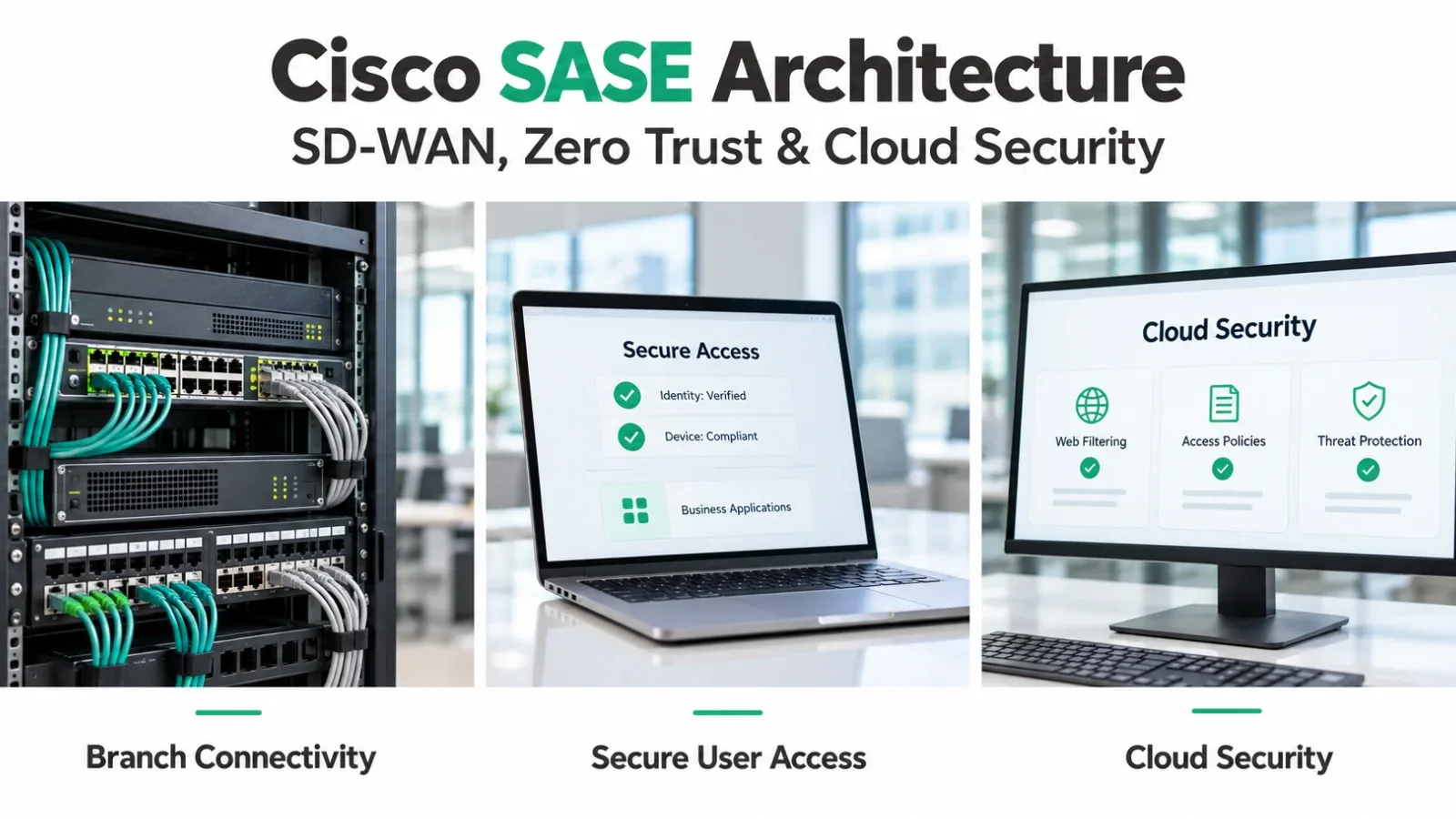
Hybrid work, cloud applications and distributed branches require both connectivity and security controls. Cisco’s SASE approach combines SD-WAN with cloud-delivered security service edge (SSE) capabilities. Cisco currently presents Catalyst SD-WAN and Secure Access as one combination for this architecture.
At its core, Cisco SASE helps IT teams simplify policy enforcement, secure distributed users, and maintain consistent security across cloud, branch, and remote access environments. In this blog, we’ll analyze how Cisco’s SASE architecture works, its supporting technologies, limitations, and future direction.
Understanding Cisco SASE Architecture
Cisco’s SASE implementation brings together multiple networking and security components into a single, integrated architecture:
SD-WAN as the Foundation
SD-WAN uses software-defined overlays and application policies to select available WAN paths. It can improve traffic steering, but cannot guarantee lower latency or replace the need for reliable underlying connectivity.
Cloud-Delivered Security Services
Cisco Secure Access provides an SSE platform with functions including:
- Zero Trust Network Access (ZTNA)
- Secure Web Gateway (SWG)
- Cloud Access Security Broker (CASB)
- Firewall-as-a-Service (FWaaS)
DNS-layer security. Cisco Umbrella is another Cisco cloud-security offering. Confirm product scope and migration requirements instead of treating Umbrella and Secure Access as identical.
Cloud-delivered security services can apply policies to covered users and traffic paths. Coverage depends on configured access methods, routing and enforcement points.
End-to-End Visibility
ThousandEyes can provide visibility into network paths and application experience when included in the design. It is not automatically included in every SASE subscription.
Why Cisco SASE Is Important Today
Cisco SASE addresses several challenges organizations face in modern networking:
1. Hybrid & Remote Workforce
ZTNA and cloud-delivered security can control application access for distributed users. Existing VPNs can remain appropriate for some applications and migration stages.
2. Cloud-First Connectivity
SASE can steer branch and user traffic toward cloud applications while applying security policy. Performance depends on the ISP, service location, routing and application.
3. Simplified Policy Enforcement
Centralized management can reduce duplicated policy work, but the exact consoles, integrations and policy coverage depend on the Cisco products and deployment selected.
4. Alignment with Zero Trust
Identity-aware access and ZTNA can support Zero Trust principles. A SASE deployment alone does not establish compliance with a security framework.
Supporting Technologies Behind Cisco SASE
Cisco’s architecture is built on several key technologies:
SD-WAN Routing & Orchestration
SD-WAN creates an overlay that selects paths based on policy and observed link conditions. MPLS, broadband and other transports may still provide the underlying connectivity.
Cloud-Native Security Stack
Cloud-delivered services can reduce some on-premises security-appliance requirements. Branch equipment, connectors, client software and subscriptions may still be required.
Analytics & Monitoring
Tools like ThousandEyes provide operational analytics and performance insights, offering visibility across cloud, WAN, and branch networks.
Possible Future Directions for SASE
AI-Driven Policy Automation
AI-assisted analysis and policy recommendations are development areas. Fully autonomous policy changes should not be assumed to be a committed feature or safe default.
Greater Cloud Integration
Further hybrid and multicloud integration is a possible direction. Confirm actual capabilities and release availability in Cisco’s current documentation.
Convergence with Zero Trust Platforms
SASE can use identity and device context for access decisions. The level of session evaluation and enforcement depends on the chosen services and policies.
Edge and 5G Optimization
SASE can be used over 5G or other access networks. The combination does not automatically reduce latency or guarantee performance for edge applications and IoT.
Cisco SASE combines networking and cloud-delivered security to support distributed users and applications. A useful design specifies SD-WAN, SSE services, identity integration, monitoring and operational ownership.
Before deployment, test representative applications, routing, service reachability and failover. Assess subscription scope, local support and ongoing policy management alongside technical features.
Practical Next Step
Document branch links, user locations, application paths and security requirements before selecting products. Discuss network and security requirements with Servicing24 Limited.
Sources and Further Reading
Common questions
What is Cisco SASE?
Cisco SASE combines SD-WAN networking with cloud-delivered security service edge capabilities for distributed users, branches and applications.
How do SASE and SSE differ?
SSE provides cloud-delivered security functions. SASE combines those security capabilities with WAN networking such as SD-WAN.
Is Cisco Umbrella the same as Cisco Secure Access?
They are distinct Cisco offerings with overlapping cloud-security functions. Confirm product scope, entitlement and migration requirements for the intended architecture.
Does SASE guarantee lower latency?
No. Latency depends on the access network, security service location, routing and application. Measure performance from the actual user and branch locations.
Is ThousandEyes included in every Cisco SASE subscription?
Do not assume it is. Confirm the monitoring functions, integrations and entitlements in the selected design and commercial offer.
Need help with this in your own setup?
Talk to a Servicing24 engineer. We’ll give you a plan and a clear price.