Key points
- TPM is maintenance delivered by an independent provider rather than the equipment manufacturer.
- Coverage can include hardware diagnosis, spare replacement, preventive maintenance, and troubleshooting.
- Server, storage, and network assets may be covered under a multi-vendor agreement.
- Define support hours, response commitments, onsite attendance, and exclusions in the SLA.
- Check spare availability, engineer capability, OEM entitlements, and actual costs before selecting a provider.
In this article
- Understanding Third Party Maintenance (TPM)
- Why Organizations Move Away from OEM AMC
- Scope of TPM Services
- TPM for Server Infrastructure
- TPM for Storage Systems (SAN / NAS)
- TPM for Network Infrastructure
- TPM vs OEM Maintenance: A Strategic Comparison
- SLA Models in TPM
- Risk Considerations & Best Practices
- When TPM Makes the Most Sense
- Conclusion
As organizations increasingly depend on IT infrastructure to run mission-critical operations, maintaining servers, storage, and network devices has become a strategic priority. Downtime, hardware failure, or delayed support can directly impact revenue, reputation, and business continuity.
TPM (Third Party Maintenance) has emerged as a powerful and cost-effective alternative to traditional OEM support models, especially for post-warranty infrastructure.
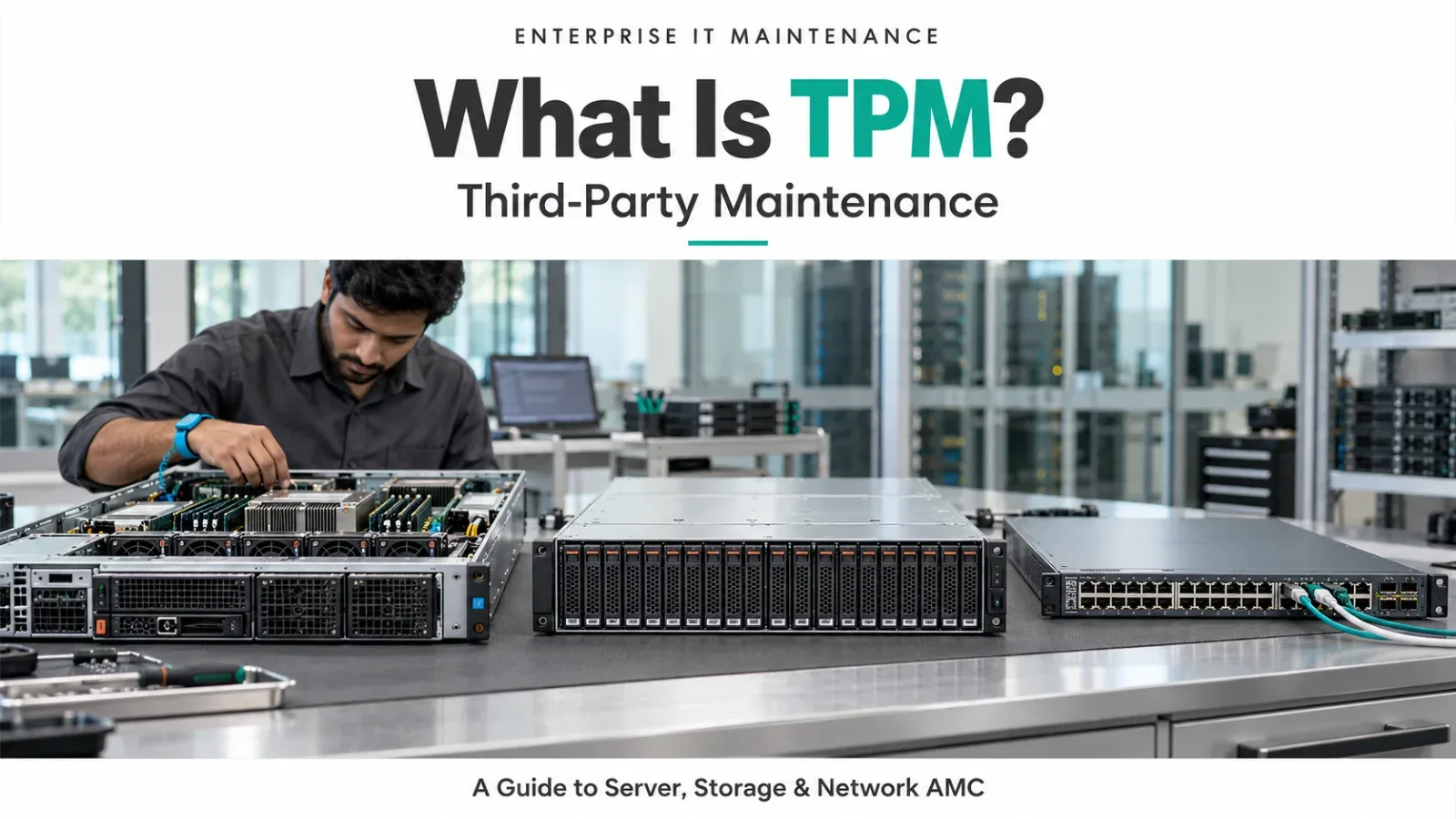
This article provides an in-depth explanation of Third-Party Maintenance, its scope, benefits, risks, and how it applies to Server, Storage, and Network AMC.
Understanding Third Party Maintenance (TPM)
Third Party Maintenance (TPM) is a professional support and maintenance service for IT infrastructure delivered by an independent service provider, not the original equipment manufacturer (OEM).
TPM typically starts after OEM warranty or OEM AMC expires and focuses on:
- Hardware break-fix support
- Preventive maintenance
- Spare parts replacement
- Onsite and remote troubleshooting
- SLA-based response and resolution
TPM is widely used in enterprise data centers, financial institutions, telecom operators, and government IT environments.
Why Organizations Move Away from OEM AMC
OEM maintenance contracts are designed around hardware sales cycles, not long-term infrastructure optimization. As systems age, OEM AMC often becomes:
- Increasingly expensive year after year
- Limited to fixed SLA models
- Focused on upgrade or replacement pressure
- Less flexible in mixed-vendor environments
TPM addresses these gaps by offering support-centric maintenance instead of sales-centric maintenance.
Scope of TPM Services
TPM is not limited to “repair when broken.” A mature TPM program includes multiple layers of service.
1. Corrective Maintenance (Break-Fix)
- Diagnosis of failed components
- Replacement of faulty parts
- System restoration and validation
2. Preventive Maintenance
- Scheduled health checks
- Hardware inspection
- Firmware stability review
- Early fault detection
3. Operational Support
- Incident response
- Configuration assistance
- Escalation management
- Root cause analysis (RCA)
TPM for Server Infrastructure
Servers are the compute backbone of enterprise IT. TPM ensures their availability and reliability long after OEM support ends.
Covered Components:
- CPU and motherboard
- Memory (RAM)
- HDD / SSD / NVMe
- RAID controllers
- Power supplies
- Cooling systems (fans, heat sinks)
Server TPM Capabilities:
- RAID degradation and rebuild support
- Boot failure troubleshooting
- Firmware stability assistance
- Hardware replacement with tested spares
- Onsite engineer dispatch based on SLA
TPM helps organizations maximize ROI on server investments by extending usable life without compromising uptime.
TPM for Storage Systems (SAN / NAS)
Storage downtime can halt business operations instantly. TPM for storage focuses on data availability and performance stability.
Storage TPM Coverage:
- SAN & NAS controllers
- Disk shelves and enclosures
- SAS / FC / iSCSI connectivity
- Cache and battery modules
Storage TPM Services:
- Disk failure replacement and rebuild
- LUN / volume offline issue resolution
- Controller failover support
- Performance and latency issue analysis
- Preventive storage health assessments
TPM is especially effective for stable storage platforms that are no longer under OEM enhancement cycles but remain production-critical.
TPM for Network Infrastructure
Network devices are essential for connectivity, security, and application access. TPM ensures consistent network availability.
Devices Covered:
- Core & access switches
- Routers
- Firewalls
- Load balancers
- Network modules and transceivers
Network TPM Services:
- Hardware break-fix
- PSU and fan replacement
- Port and module failure support
- Configuration backup and recovery
- Emergency onsite response
A key advantage of TPM is multi-vendor network support, allowing organizations to manage Cisco, HPE, Juniper, Fortinet, and others under a single AMC.
TPM vs OEM Maintenance: A Strategic Comparison
Cost
- OEM AMC: High and escalating
- Third Party Maintenance: 50–70% cost reduction
Vendor Flexibility
- OEM AMC: Single vendor
- Third Party Maintenance: Multi-vendor
Hardware Lifecycle
- OEM AMC: Shortened
- Third Party Maintenance: Extended
SLA Customization
- OEM AMC: Limited
- Third Party Maintenance: Highly flexible
Upgrade Pressure
- OEM AMC: High
- Third Party Maintenance: Minimal
Support Focus
- OEM AMC: Product-centric
- Third Party Maintenance: Customer-centric
SLA Models in TPM
TPM providers typically offer customizable SLAs, such as:
- 24×7×4 hours onsite support
- Next Business Day (NBD)
- 8×5 business hours
- Mission-critical response models
This flexibility allows businesses to align maintenance cost with system criticality.
Risk Considerations & Best Practices
While TPM offers major advantages, success depends on choosing the right partner.
Key Evaluation Criteria:
- Certified and experienced engineers
- Local spare inventory availability
- Clear escalation and SLA governance
- Detailed service documentation
- Proven enterprise references
A professional TPM provider mitigates risk through process, expertise, and accountability.
When TPM Makes the Most Sense
TPM is ideal when:
- Infrastructure is stable and production-ready
- OEM support costs exceed business value
- Hardware is post-warranty but business-critical
- Budget optimization is a priority
- Multi-vendor environments exist
Conclusion
Third Party Maintenance (TPM) is no longer just a cost-saving option. It is a strategic IT maintenance model. By extending the life of servers, storage, and network infrastructure, TPM enables organizations to maintain uptime, control costs, and make smarter technology investments.
For enterprises seeking reliability without unnecessary upgrades, TPM delivers the right balance between performance, cost efficiency, and operational control.
- #Third Party Maintenance
- #TPM
- #server AMC
- #storage AMC
- #network AMC
- #post-warranty support
- #preventive maintenance
- #multi-vendor maintenance
- #SLA-based support
Need help with this in your own setup?
Talk to a Servicing24 engineer. We’ll give you a plan and a clear price.