Key points
- Funding announced on 26 January 2026
- Series A raised $300 million
- Post-money valuation was $4 billion
- Under two months refers to the public launch
- Valuation does not prove product performance
In this article
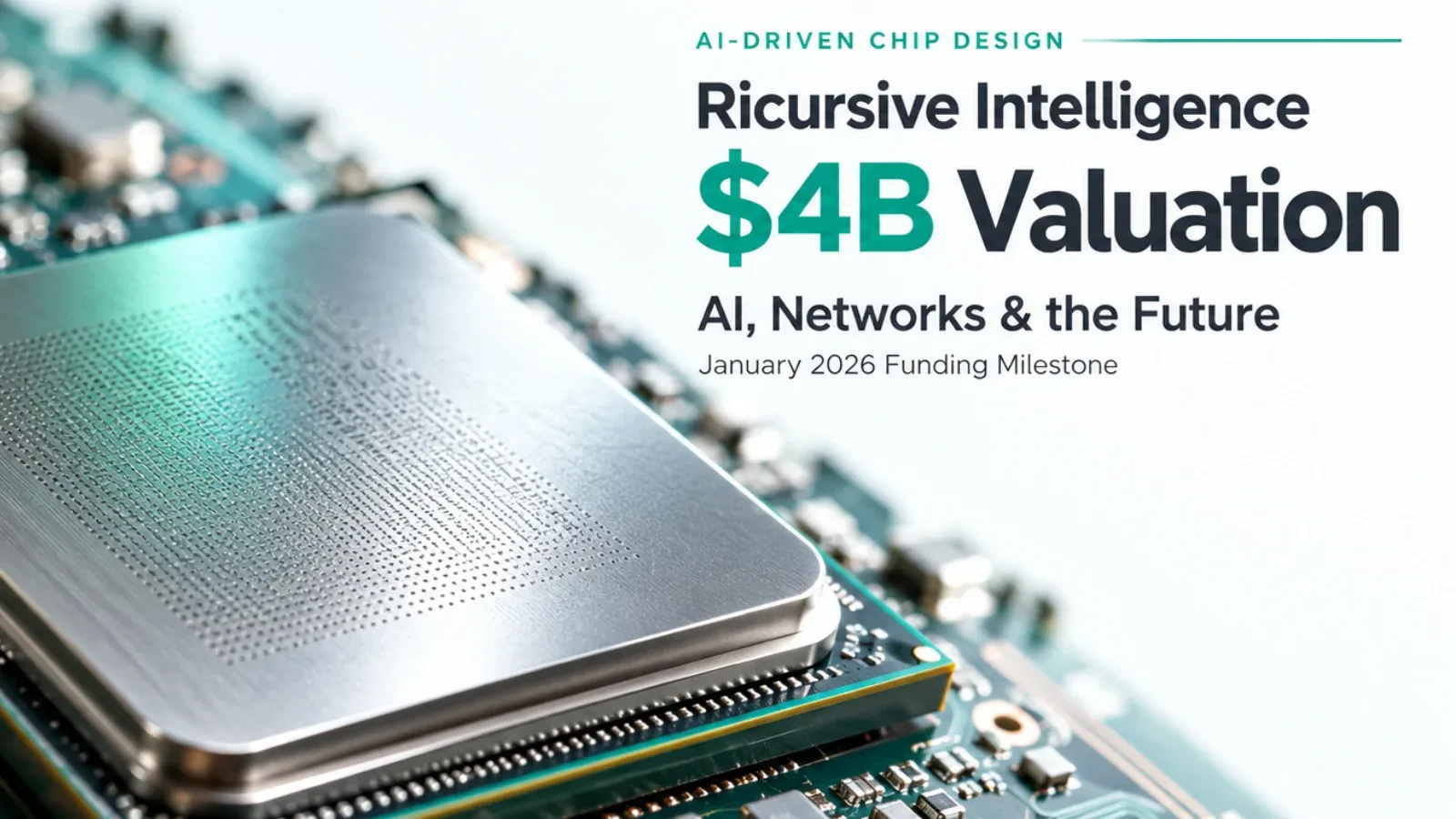
On 26 January 2026, Ricursive Intelligence announced a $300 million Series A led by Lightspeed Venture Partners at a $4 billion post-money valuation. Its announcement said the round followed its public launch less than two months earlier. Investors included DST Global and NVentures, NVIDIA’s venture capital arm. Ricursive’s website reports $335 million in backing.
Ricursive aims to use AI to accelerate chip design and improve the relationship between AI models and the hardware that runs them. This is the company’s stated mission. The funding announcement does not establish that fully autonomous chip design or artificial general intelligence has been achieved.
This guide reviews the funding milestone, everyday uses of AI, possible applications in network security and the limits of what this announcement establishes.
How AI Helps Us in Our Daily Lives
Artificial Intelligence has moved far beyond academic research, it’s now deeply embedded in everyday life. From the moment we wake up with AI-powered voice assistants to navigation apps that find optimized routes, AI impacts our routines:
- Smart assistants like Siri, Google Assistant, and Alexa help with tasks and reminders.
- Personalized recommendations on streaming platforms and shopping apps improve user experience.
- Health tracking apps use AI to interpret biometric data and suggest improvements.
- Predictive text and language tools help us write emails and messages faster.
These AI tools make tasks easier, faster, and more intuitive, even if we don’t always notice them working behind the scenes.
Why AI Growth Is Increasing in Network & Security Technology
AI-assisted analysis is relevant to network operations and security in several ways:
1. AI Enhances Network Performance
Depending on the platform, AI-assisted network tools can analyze traffic patterns and recommend or automate routing and congestion-management actions. Results depend on telemetry, policy and deployment conditions.
2. Intelligent Threat Detection
Behavioral analytics and machine learning can help identify suspicious activity that signature-only detection misses. They can also produce false positives and miss attacks, so their alerts need validation.
3. Automated Response
Some security platforms can automate actions such as quarantine or isolation. Their usefulness depends on detection quality, authorization and the operational effect of the action.
4. Scalability
AI-assisted tools can help teams manage larger, more distributed environments. They still require reliable data, defined permissions and operational oversight.
These capabilities can support network security and incident response. Their value depends on tested detection, response workflows and the wider security architecture.
What Ricursive’s Growth Says About AI’s Momentum
Ricursive’s January 2026 funding is an example of investor interest in AI infrastructure and chip design. A funding valuation reflects the financing terms, rather than proven product performance or customer ROI.
Why is this important?
AI chip design is a strategic research area. Workload-specific hardware can improve performance or energy efficiency when its design matches the applications being run.
Automation in hardware design: Ricursive aims to use AI to accelerate semiconductor development. The scale of any future development-time or performance gains remains to be demonstrated.
Investor interest: The financing shows support for Ricursive’s approach. It does not establish which companies or technologies will lead the market.
For enterprise IT buyers, the practical lesson is to assess infrastructure requirements and measured results rather than treating a startup valuation as a procurement signal.
Future Vision of AI Technology
Possible development areas include:
- AI-driven R&D: AI can support simulation and analysis in fields such as drug discovery and materials research.
- Autonomous systems: AI can support robotics and automated decision-making, with deployment constrained by safety, validation and operating conditions.
- Healthcare applications: AI can assist analysis and health-monitoring workflows. Clinical effectiveness requires separate evidence and appropriate oversight.
- Smarter infrastructure security: AI-assisted tools may improve analysis and response across networks, cloud environments and IoT. No platform guarantees that it will prevent every attack.
These are possible development directions, rather than guaranteed outcomes or announced delivery dates.
Ricursive’s January 2026 funding highlights investment in the hardware and software needed for AI development. Its direct effect on enterprise network and security products remains uncertain.
Businesses should follow the technology while prioritizing tested infrastructure, application compatibility, supportability and a measurable business case.
Practical Next Step
Before committing to AI infrastructure, review the application workload, network capacity, security controls and support requirements. Discuss your infrastructure requirements with Servicing24 Limited.
Sources and Further Reading
Common questions
When did Ricursive announce its $4 billion valuation?
The company announced its $300 million Series A at a $4 billion post-money valuation on 26 January 2026.
What does “under two months” refer to?
Ricursive’s funding announcement measured the interval from its public launch. It should not be read as the complete time spent developing the company or its technology.
What is Ricursive trying to build?
The company aims to use AI to accelerate semiconductor design and improve the relationship between AI models and the chips that run them.
Does the valuation prove the technology is commercially ready?
No. A funding valuation reflects financing terms and investor expectations. Commercial readiness and performance require separate evidence.
What should enterprise IT teams take from this news?
Follow AI infrastructure developments, but base purchasing decisions on tested workloads, compatibility, supportability and a measurable business case.
Need help with this in your own setup?
Talk to a Servicing24 engineer. We’ll give you a plan and a clear price.