Key points
- Firewall value depends on policy and placement
- Segmentation rules restrict unauthorized traffic
- TLS inspection has technical and privacy limits
- Patching and management hardening remain essential
- Historical announcements retain their original dates
In this article
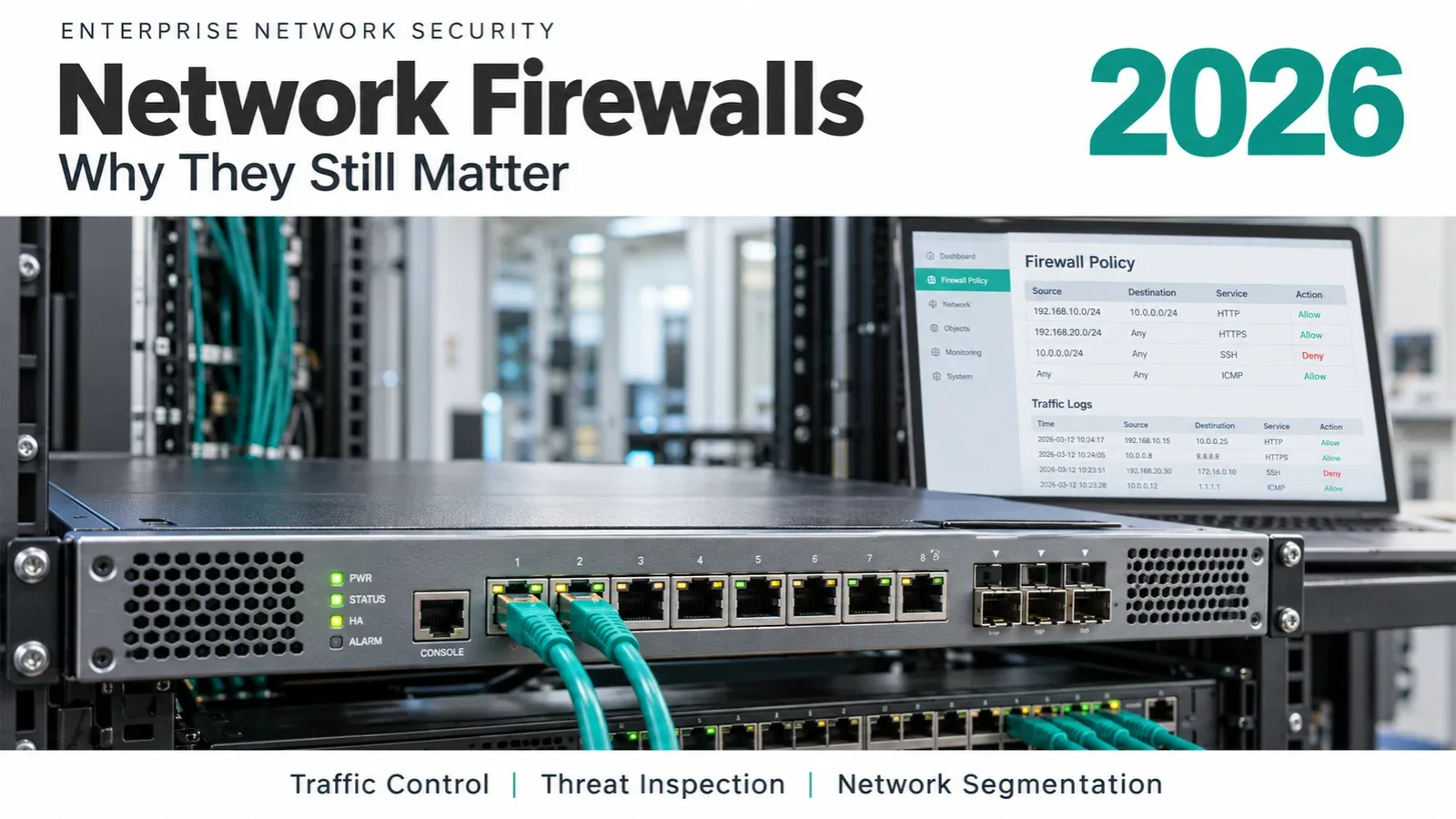
A network firewall is a device or software that controls the flow of traffic between networks or hosts with different security levels, based on policies you define. Done right, it’s one of the most effective ways to reduce risk and limit damage when something goes wrong.
Modern firewalls can add application awareness, intrusion prevention, TLS inspection and identity-based policies to traditional traffic filtering. Availability, performance and subscription requirements vary by vendor, model and software version.
How Network Firewalls Protect Us in Our Existing Network
Even if your organization already uses endpoint security (EDR/XDR), IAM, VPN/Zero Trust access, and monitoring, a network firewall still plays a critical role:
1) Enforces policy at the “choke points”.
Firewalls let you enforce consistent rules for inbound/outbound traffic (internet edge, DC edge, branch WAN, cloud VPC/VNet). NIST emphasizes that effective firewall security depends heavily on a well-defined firewall policy and proper deployment/testing.
2) Reduces the blast radius (limits lateral movement)
When traffic passes through the relevant enforcement point, firewall rules and segmentation can restrict unauthorized movement toward systems such as directory services, databases and backups. Traffic that bypasses that control needs protection elsewhere.
3) Protects remote access paths
Remote-access services can expose an entry point if they are vulnerable or misconfigured. Keep supported firewall software patched, restrict management access and review authentication settings.
4) Adds deep inspection where endpoints can’t
A firewall can inspect traffic from devices that cannot run an endpoint agent. TLS inspection requires supported decryption, certificate handling and appropriate privacy exceptions. It does not make every encrypted session visible.
Why Organizations Review Firewall Coverage
1) More cloud + more hybrid networks
Traffic is no longer just “office → internet.” It’s branch ↔ SaaS, users ↔ cloud apps, workloads ↔ workloads. This expands the need for consistent firewalling across data center + cloud + branches.
2) Internet-Facing Devices Need Hardening
Routers, VPN gateways and firewalls need secure configuration and vulnerability management. Firewall deployment does not remove the need to secure the firewall itself.
3) “Firewall as a platform” is now expected
Customers want firewalls integrated with identity, SIEM/SOAR, SD-WAN, SASE, and threat intel, so security becomes faster and more automated.
4) Refresh and Subscription Planning
Plan firewall replacement and renewals around support coverage, capacity, enabled security services and current quotations.
The Future Vision of Network Firewall Technology
Several development directions are relevant, but availability must be checked against current product documentation:
A) AI-assisted prevention + autonomous operations
Vendors are adding more AI-driven detection/prevention, smarter policy recommendations, and faster incident response.
B) Stronger encryption visibility (TLS inspection done safely)
TLS inspection can improve visibility where decryption is technically supported and permitted. Capacity planning should use inspection-enabled performance, rather than basic firewall throughput alone.
C) Cloud and Virtual Firewall Options
Deployment options include:
- Cloud provider native firewalls (AWS Network Firewall, Azure Firewall)
- Virtual NGFWs
- SASE/SSE integrated firewalling
D) Quantum-safe and “future crypto” readiness
Some vendors discuss post-quantum cryptography in product roadmaps. Verify the supported protocol, release and interoperability before making a deployment claim.
Documented Firewall Updates and Operational Priorities
Cloud Firewall Updates
AWS Network Firewall documentation describes TLS inspection. Check the required TLS configuration, routing and service limitations before deployment.
AWS Network Firewall supports AWS Marketplace managed rule groups. The applicable rule provider, fees and coverage should be reviewed before use.
On 21 November 2025, AWS announced flexible cost allocation for Network Firewall through Transit Gateway native attachments, allowing data-processing costs to be distributed across accounts.
Microsoft published Azure Firewall packet-capture troubleshooting guidance on 10 November 2025. The guidance illustrates an operational capability rather than an upcoming release.
Major Vendor / NGFW Updates (signal of where the market is going)
Check Point announced Quantum Firewall Software R82.10 on 4 December 2025, describing AI-related protections and expanded Zero Trust capabilities.
For Palo Alto Networks and other NGFW platforms, consult the exact software release notes and security advisories for the deployed version. Confirm support status and upgrade recommendations before changing production systems.
Security advisories (why patching & hardening matters)
Maintain an inventory of firewall models, software releases, enabled services and subscriptions. Review the manufacturer’s advisories, backup configurations and test changes before a production rollout.
Development Directions to Evaluate
- More AI-driven prevention + automation
- More cloud-delivered firewalling and managed rule ecosystems
- Better encrypted traffic visibility (TLS inspection + performance)
- Deeper integration with Zero Trust (identity-based policy + segmentation)
Practical Next Step
Start with a review of firewall software, subscriptions, rules, inspection settings and recovery arrangements. Discuss firewall support requirements with Servicing24 Limited.
Sources and Further Reading
Common questions
Do firewalls still matter when EDR is installed?
Yes. EDR monitors supported endpoints, while firewalls enforce traffic policy at network or host boundaries. Their coverage is complementary.
Does a firewall inspect all encrypted traffic?
No. TLS inspection depends on decryption support, certificates, routing and configured exceptions. Some sessions cannot or should not be decrypted.
Can a firewall limit lateral movement?
It can restrict traffic that passes through its enforcement point. Same-segment or bypass traffic requires other controls.
Which throughput figure should be used for sizing?
Review performance with the intended IPS, malware prevention and TLS inspection enabled, together with session and connection-rate requirements.
What maintenance does a firewall need?
Review advisories, supported software, subscriptions, administrative access, rules, logs, configuration backups and failover tests.
Need help with this in your own setup?
Talk to a Servicing24 engineer. We’ll give you a plan and a clear price.