Key points
- EDR monitors and investigates endpoint activity
- XDR correlates signals across security layers
- MDR is a managed detection and response service
- Prevention and recovery remain necessary
- Response ownership matters as much as the tool
In this article
Businesses need to protect endpoints against malware, credential abuse and suspicious activity that basic signature-based antivirus can miss. EDR, XDR and MDR add detection, investigation and response capabilities, but they do not make malware prevention, patching or backups unnecessary.
This guide explains the different roles of EDR, XDR and MDR, how they complement endpoint protection, and what IT teams should evaluate before adopting them.
What Is Endpoint Security (and How It Works)
Endpoint security protects devices (“endpoints”) that connect to your network, including desktops, laptops, servers, mobile devices, and IoT systems.
Modern endpoint platforms can combine signatures, behavioral detection, analytics and automation. Capabilities vary by product and supported operating system.
Key modern technologies:
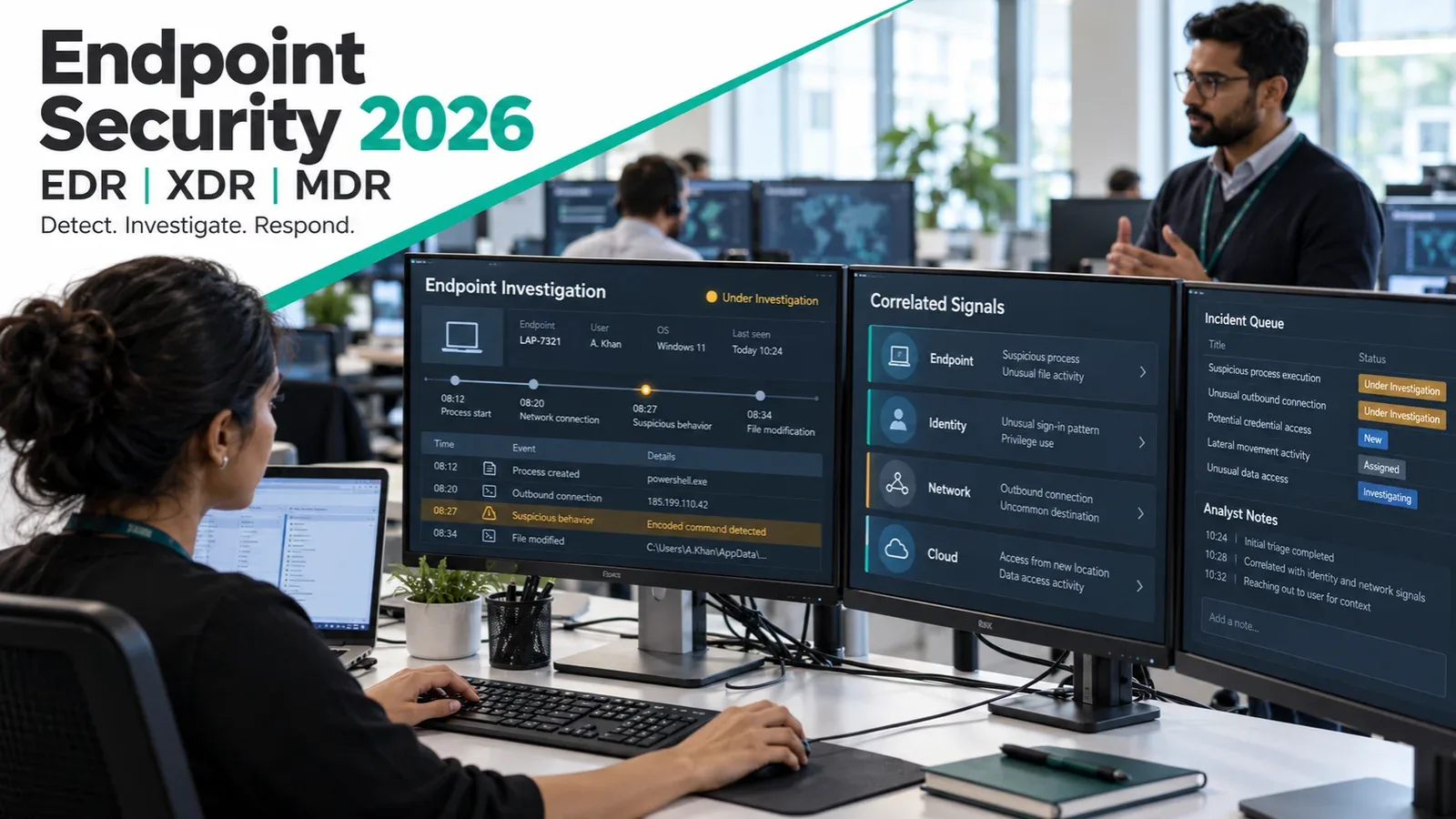
- EDR (Endpoint Detection & Response): Detects suspicious activity on endpoints and allows security teams to investigate and respond.
- XDR (Extended Detection & Response): Correlates data from endpoints, network, email, cloud, and logs for broader visibility and response.
- MDR (Managed Detection & Response): Outsourced service combining tools with expert security analysts to monitor, detect, and respond.
Why Organizations Add EDR and XDR to Antivirus
1) Signature-Only Detection Has Limits
Basic signature-only antivirus looks for known malware patterns. Modern antivirus can also use behavioral and machine-learning techniques. EDR adds activity monitoring, investigation and response, including visibility into fileless or living-off-the-land activity.
2) Attackers Move Fast and Hide Well
Modern attacks may dwell inside networks for weeks before being detected. EDR continuously monitors endpoint activity and can detect stealthy breaches. XDR extends that visibility to network and cloud signals.
3) Automated Response Is Required
EDR/XDR can trigger automatic mitigation steps, like isolating an infected device, reducing the time attackers have to cause damage.
4) Distributed Environments Need Broader Visibility
Centralized antivirus can manage large fleets, but antivirus alone does not provide the cross-domain correlation associated with XDR. The relevant distinction is coverage and response capability, rather than fleet size alone.
Why Endpoint Security Demand Is Rising
1. More Remote and Hybrid Work
With distributed workforces and remote access, endpoints have become high-risk entry points. Security teams need advanced detection across all devices.
2. More Types of Threat Activity
Ransomware, supply-chain compromise and credential misuse create different detection challenges. Endpoint and identity telemetry help teams investigate suspicious activity across those attack paths.
3. Regulatory and Compliance Pressure
Compliance obligations can require appropriate security controls, logging and evidence. Requirements depend on the applicable framework and scope. Selecting an EDR or XDR platform alone does not establish compliance.
4. Cloud-First Adoption
As more tools and data move to cloud, endpoint security must integrate with cloud logs, identity systems, and user behavior analytics, again favoring EDR/XDR/MDR.
Development Directions in Endpoint Security
Areas to evaluate include:
i. AI + Machine Learning
AI and machine learning can help analyze endpoint and related security signals. Detection quality depends on training, telemetry and the environment being monitored.
ii. Behavior-Driven Detection
Instead of signature hunts, systems learn “normal” behavior and flag deviations, even if it doesn’t match any known malware.
iii. Cross-Layered Security
XDR can combine signals across endpoint, network, cloud, email and identity systems. The available integrations and response actions depend on the chosen platform.
iv. Autonomous Response
Some platforms can automate actions such as device isolation and quarantine. Rollback and remediation support vary by product and attack type. Set approval rules for actions that could interrupt business services.
v. MDR for SMBs
Organizations without a fully staffed security operations team can consider MDR. Check the contracted monitoring hours, supported systems, escalation process and response authority.
Platform Capabilities to Evaluate
Unified Platforms
Leading vendors are blurring lines between EDR and XDR, offering tighter integration with SIEM, SOAR, cloud workload protection, and identity systems.
AI-Assisted Detection
Security tools can use machine learning to help identify suspicious activity and recommend remediation. Accuracy and false-positive rates need to be assessed in the customer’s environment.
Cloud Delivered Protection
Endpoint security is moving toward cloud-hosted management, enabling roaming user protection and faster deployment without heavy on-prem infrastructure.
Integration with Zero Trust
Endpoint posture can inform Zero Trust access decisions alongside identity, risk and resource sensitivity. The frequency of reevaluation depends on policy and product capabilities.
Endpoint security combines prevention with detection and response. EDR focuses on endpoint activity, XDR connects signals from multiple security layers, and MDR provides a managed service that can use these tools.
Choose the combination that matches device coverage, business risk and the team’s ability to investigate alerts. A product purchase alone does not establish an effective response operation.
Practical Next Step
List the devices you need to cover, the alerts your team can investigate and the response actions it can authorize. Discuss endpoint security requirements with Servicing24 Limited.
Sources and Further Reading
Common questions
How do EDR, XDR and MDR differ?
EDR focuses on endpoint activity. XDR correlates signals across several security layers. MDR is a managed service that can use EDR, XDR and other tools.
Does EDR make antivirus unnecessary?
EDR adds investigation and response. Antivirus or endpoint prevention remains useful, and many platforms combine these capabilities.
Can XDR connect every security tool automatically?
No. Supported connectors, data access, licensing and response actions vary by platform. Confirm integration with the systems you use.
When should a business consider MDR?
Consider MDR when the team needs help monitoring, investigating and responding to alerts. Check service hours, covered systems and escalation authority.
What should be tested before endpoint security deployment?
Test operating-system support, agent performance, detection quality, exclusions, alert handling and the effect of isolation actions on critical services.
Need help with this in your own setup?
Talk to a Servicing24 engineer. We’ll give you a plan and a clear price.